Selling Gold Coins: Bullion vs. Collectible, and How to Get a Fair Price
Gold coins can be easier to sell than jewelry because many are standard sizes with known gold content. But some coins are worth more than their gold, and some are worth only their gold. Knowing which kind you have is the first step to a fair price.
Not financial advice. This guide is general education. Prices change daily and no one can promise what gold will be worth. Check with a licensed professional before making money decisions.
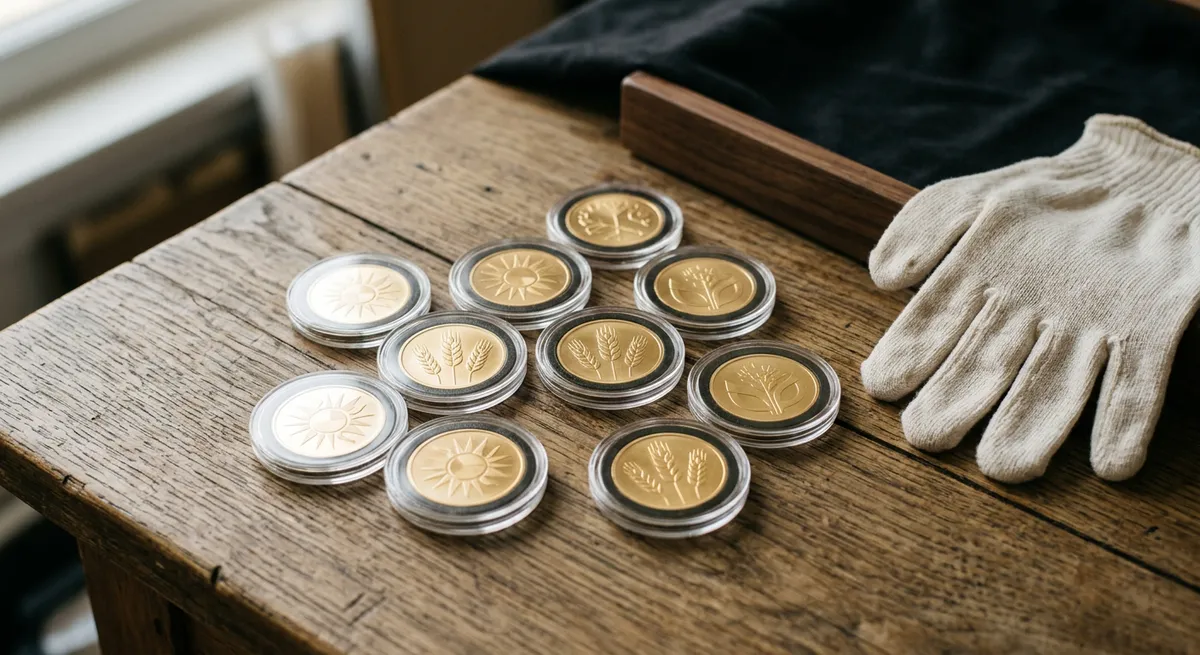
Two kinds of gold coins
Bullion coins are made mainly for their metal. Their value follows the gold "spot price" (the market price of an ounce of gold) plus or minus a small amount. Common examples include modern one-ounce coins issued by national mints. They state their gold content on the coin, such as "1 oz fine gold."
Numismatic (collectible) coins are valued for rarity, age, condition, and demand among collectors, in addition to their gold. Older U.S. gold coins, rare dates, and coins in excellent condition can be worth more than their melt value. Some are worth far more.
Before you sell, figure out which group your coins belong to. Selling a valuable collectible coin at bullion price is one of the most expensive mistakes a seller can make.
How to identify your coins
- Read the coin. Note the country, the date, the denomination, and any statement of weight and fineness.
- Look up the coin in a reputable coin catalog or a major mint's website to find its official gold content.
- Check for grading. If the coin is in a sealed plastic holder ("slab") from a grading service, the label shows its grade and a certification number you can look up online.
- Don't clean coins. Cleaning can scratch the surface and greatly reduce a collectible coin's value. Handle them by the edges.
Work out the gold value
For bullion coins, the value starts with the actual gold weight (AGW). A coin marked "1 oz" contains one troy ounce of pure gold, even if the coin itself weighs a bit more because it's an alloy. Multiply the gold content in troy ounces by today's spot price to get the melt value. Our melt value calculator can help, and our guide to troy ounces and pennyweights explains the units.
Understand "bid" and "ask"
Dealers buy at a "bid" price and sell at an "ask" price. The difference is the "spread," which is how they cover costs and make a profit. When you sell, you receive the bid price. For popular bullion coins, dealers often pay close to spot, sometimes a bit above or below depending on the coin and market demand. For less common coins, the spread can be wider.
Ask every dealer: "What's your buy price for this coin as a percentage of spot, or a dollar amount over or under spot?" That makes offers easy to compare.
Where to sell gold coins
| Buyer | Pros | Cons |
|---|---|---|
| Local coin shop | Fast, in-person, can recognize collectible coins | Offers vary; get several |
| Large online bullion dealer | Published buy prices for common coins | Shipping and insurance needed; payment takes days |
| Coin show | Many dealers in one room to compare | Only on certain dates |
| Auction house | Can bring top prices for rare coins | Fees and waiting time |
| Online marketplace | You set the price | Fees, fraud risk, shipping risk |
| Pawn shop or "we buy gold" store | Quick cash | Often lower offers for coins |
Our guide to where to sell gold covers buyer types in more depth, and selling gold by mail explains shipping safely.
If you might have a collectible coin
- Get opinions from more than one dealer, or a professional appraisal.
- Consider professional grading for high-value coins. Grading costs money, so ask a dealer first whether it's worth it.
- Ask whether an auction might bring more than a direct sale.
- Be wary of anyone who immediately offers "melt value" for an old coin without looking it up.
Tips for getting a fair price
- Check the spot price the same day you sell.
- Get at least three quotes for the same coins.
- Sell common bullion coins in a group; some dealers pay slightly better for larger lots.
- Keep coins in protective capsules so their condition doesn't suffer.
- Get a written receipt listing each coin, its price, and the date.
Paperwork and taxes
Dealers may ask for ID and, for certain coins in certain quantities, may have to file reports with the IRS. Separately, you may owe tax on any gain. In the U.S., gold is generally treated as a "collectible" for tax purposes, which can mean different rates than stocks. Keep your purchase records. Read taxes when you sell gold and talk with a tax professional.
Watch for scams
- Unsolicited calls offering to buy your coins or "swap" them for supposedly better ones.
- Pressure to decide on the spot.
- Buyers who won't tell you the spot price they're using.
- Requests to ship coins before you've confirmed who the buyer is.
More warning signs are in avoid gold selling scams.
Inherited a coin collection?
If you inherited coins, take your time. Make a simple list of every coin: country, date, denomination, and whether it is in a holder. Photograph each one front and back. Then ask two or three dealers to look at the whole collection, and ask which coins they think are collectible rather than bullion. Selling the bullion coins first and holding the possible rarities for expert review is a common approach. If the estate is large, an estate attorney or appraiser can help with valuation for tax and legal purposes.
What about gold bars?
Gold bars from well-known refiners are bought much like bullion coins, priced relative to spot. Keep any assay card or certificate that came with a bar, because it can make selling easier. Small bars often carry a slightly higher spread than larger ones. Dealers may want to test bars that have no assay card.
The bottom line
Identify whether each coin is bullion or collectible, work out its gold content and melt value, and compare at least three buy offers stated against spot price. For rare or old coins, get expert opinions before selling. Keep records for taxes. This guide is general education, not financial or tax advice.
Common questions
How much will a dealer pay for a gold coin?
For common bullion coins, often close to the spot price of the gold inside, sometimes slightly above or below. Collectible coins can be worth more.
Should I clean old gold coins before selling?
No. Cleaning can scratch coins and lower the value of collectible coins a lot.
Do I have to pay tax when I sell gold coins?
You may owe tax on a gain. In the U.S., gold is generally treated as a collectible. Talk with a tax professional.
Coin care supplies
- Coin capsules – protect coins while you shop around: see on Amazon · see on eBay(paid links)
- Cotton gloves – avoid fingerprints: see on Amazon · see on eBay(paid links)
- Digital jewelry scale (0.01 g): see on Amazon · see on eBay(paid links)
These are search links. Compare a few options and read the seller’s details before you buy. As an Amazon Associate we earn from qualifying purchases; we may also earn from eBay Partner Network links, at no extra cost to you.