How to Tell if Gold Is Real: 7 Simple Checks at Home
Before you sell or buy gold, it helps to know whether it's real, solid gold or just gold-colored. A few simple checks at home can rule out many fakes. None of them is perfect, so the final answer should come from a professional test.
Not financial advice. This guide is general education. Prices change daily and no one can promise what gold will be worth. Check with a licensed professional before making money decisions.
Why checking matters
Lots of jewelry looks like gold but is mostly another metal with a thin gold layer on top. Costume jewelry, gold-plated pieces, and "gold filled" items can be lovely, but they are worth far less than solid gold when you sell. Knowing what you have helps you avoid disappointment and helps you spot a buyer who isn't being honest. Our guide to selling gold for a fair price explains the next steps.
Check 1: Look for a stamp (hallmark)
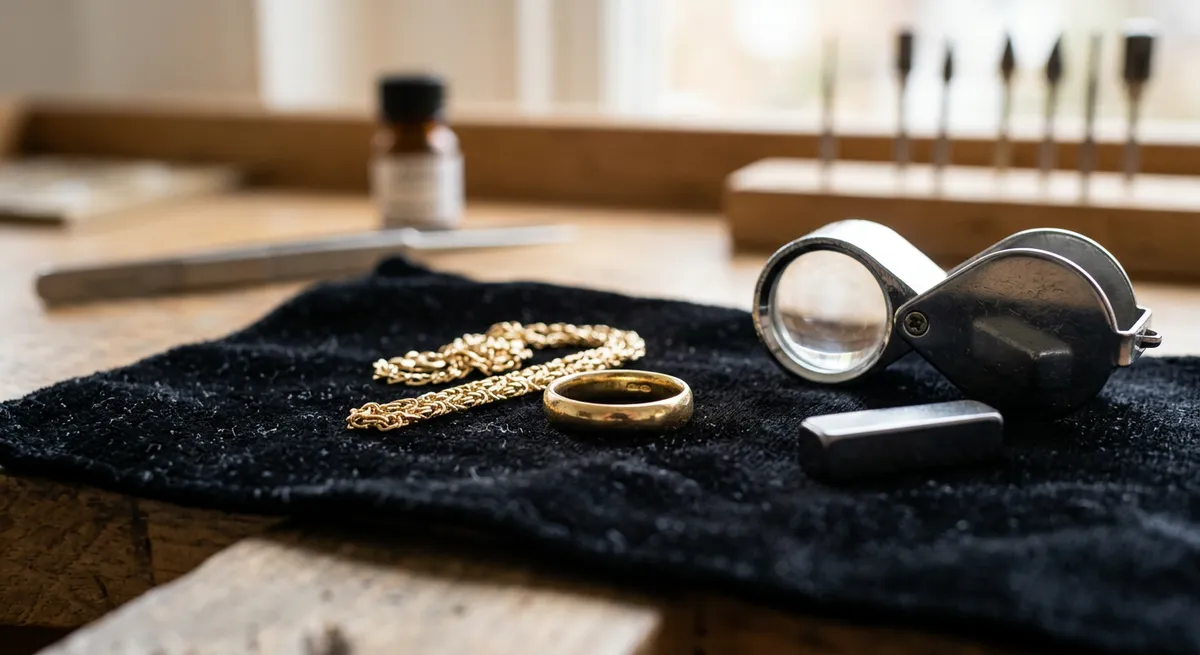
Most solid gold jewelry made in the U.S. and many other countries has a small stamp showing its purity. Use a magnifying glass or jeweler's loupe and look inside ring bands, on clasps, and near the ends of chains.
| Stamp | Meaning |
|---|---|
| 10K or 417 | About 41.7% gold |
| 14K or 585 | About 58.5% gold |
| 18K or 750 | 75% gold |
| 22K or 916 | About 91.6% gold |
| 24K or 999 | About 99.9% gold |
Watch for stamps that mean plated or filled: GP (gold plated), GEP (gold electroplated), HGE (heavy gold electroplate), RGP (rolled gold plate), and GF or "1/20 14K GF" (gold filled). These have only a thin layer of gold. A stamp is a good clue, but fakes can be stamped too, and old or worn pieces may have no stamp at all. Read karats and melt value to understand what each number means for value.
Check 2: The magnet test
Gold is not magnetic. Hold a strong magnet (a small neodymium magnet works best) near the piece. If it jumps to the magnet or sticks firmly, it's very likely not solid gold, or it has a lot of iron or nickel inside. If it doesn't stick, that's a good sign but not proof: many non-gold metals, like brass, copper and aluminum, are also not magnetic. Note that clasps often contain a small steel spring, so test the main part of the chain, not just the clasp.
Check 3: Look for wear and color changes
Look closely at edges, clasps, and places that rub against skin. If you see a different colored metal showing through, such as silver, copper or reddish metal, the piece is likely plated. Solid gold is the same color all the way through, even where it's worn.
Check 4: The skin test
Some people notice that cheap metals leave a green or black mark on their skin after wearing. Solid gold of higher karats rarely does this. It's not a reliable test on its own (sweat, lotions and lower-karat alloys can also cause marks), but it can be a clue.
Check 5: Feel the weight
Gold is very dense, so real gold pieces often feel heavier than you expect for their size. This is a rough clue only. If you have a digital jewelry scale that measures to 0.01 grams, write down the weight. You'll need it later to estimate melt value. Our guide to pennyweight and grams explains the units buyers use.
Check 6: The ceramic streak test (use caution)
Some guides suggest gently rubbing a piece on the unglazed bottom of a ceramic plate: a gold streak suggests gold, a black streak suggests another metal. This scratches your item, so only try it on an inconspicuous spot of something you plan to sell for scrap, and never on a valuable or antique piece. Many people skip this one.
Check 7: Consider where it came from
A heavy "gold" chain bought very cheaply on vacation or from an online marketplace is more likely to be plated. A piece from a known jeweler with a receipt or appraisal is more likely to be what it says. Paperwork isn't proof, but it helps.
Tests to avoid at home
- Acid tests without training. Gold testing acids are strong chemicals that can burn skin and damage items. If you use a kit, follow every safety direction, wear gloves and eye protection, and work in a ventilated area. Many people prefer to let a professional do it.
- The "bite test." It can damage your teeth and your gold, and it doesn't prove anything.
- Vinegar or bleach soaks. These can damage stones, pearls and finishes.
- Lighters or heating. This can damage stones and solder joints and isn't reliable.
When to get a professional test
Most reputable gold buyers and jewelers can test gold for you, often for free, using acid testing, an electronic tester, or an X-ray fluorescence (XRF) machine. XRF can read metal content without damaging the piece. For valuable items, antique pieces, or anything with diamonds or gemstones, consider an independent appraiser who isn't trying to buy from you.
Ask to watch the test and to see the result. A trustworthy buyer will explain what they found. Our guide to avoiding gold selling scams lists other warning signs.
Coins and bars
Gold coins and bars from well-known mints have specific sizes, weights and designs. Fakes exist, especially of popular bullion coins. Checking the exact weight and diameter against the mint's published numbers is a good first step, but if you're unsure, have a coin dealer verify them. See selling gold coins.
Sort while you test
As you go, make piles: stamped solid gold by karat, plated or filled, unknown, and items with stones. Put each pile in a labeled bag. This makes getting quotes much easier, because buyers price each karat differently.
The bottom line
Start with the stamp and the magnet, look for worn spots, and weigh your pieces. These simple checks rule out many fakes. For a final answer, especially on valuable items, ask a professional to test the gold in front of you. This guide is general information, not financial advice.
Common questions
Does a 14K stamp prove gold is real?
It is a strong clue but not proof, since fake pieces can be stamped. A professional test gives a reliable answer.
Is real gold magnetic?
No. If a piece sticks strongly to a magnet it is likely not solid gold, but non-magnetic metals can also be fakes.
What does GF mean on jewelry?
GF means gold filled: a layer of gold bonded over another metal. It contains much less gold than solid gold jewelry.
Tools for home checks
- Jeweler's loupe 10x – read tiny stamps: see on Amazon · see on eBay(paid links)
- Strong small magnet: see on Amazon · see on eBay(paid links)
- Digital jewelry scale (0.01 g): see on Amazon · see on eBay(paid links)
These are search links. Compare a few options and read the seller’s details before you buy. As an Amazon Associate we earn from qualifying purchases; we may also earn from eBay Partner Network links, at no extra cost to you.